

Our Services
we offer private-pay, teletherapy services in NJ, NY, CA, and TX,
and parent coaching across the US.
You Might Be Wondering:
Why should I see a stuttering specialist?
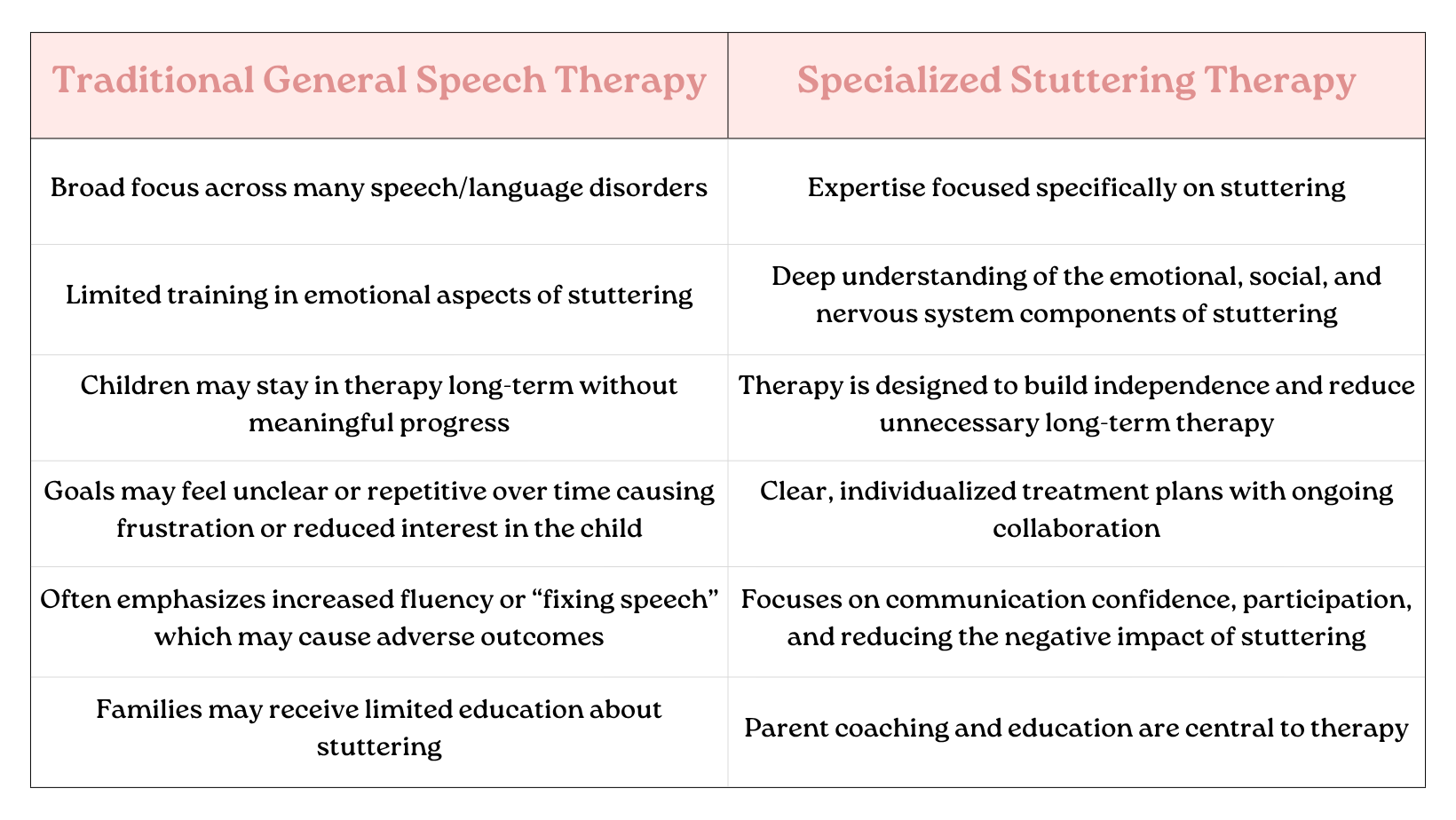
Many families come to us after seeing minimal progress with years and years of speech therapy or when they feel conflicted about the therapy approach their child’s SLP is using. This is because children who stutter benefit most from therapy that is provided by an SLP who is trained in treating stuttering specifically — not just general speech therapy. At our practice, stuttering (and cluttering) is all we do. Our approach is evidence-based and up to date with the most recent research and findings for what works and what feels good to people who stutter.
Okay, but what is the difference really?
Why would I pay privately when I could use my insurance elsewhere?
Families choose to work with us through private-pay therapy because it allows for:
Highly individualized treatment rather than insurance-driven models
Direct access to specialized expertise in stuttering
Longer sessions, parent coaching, and collaborative care
Flexible, relationship-based treatment plans
Faster accessto services without long waitlists or insurance restrictions
Ongoing clinician training and advanced specialization
Our goal is not to keep children in therapy forever — it’s to provide meaningful, effective support so people who stutter can see lasting changes. We work to build confident and resilient communicators, and solid support systems.
Will teletherapy work for me or my child?
First and foremost: PRESCHOOLERS will not be in front of a computer with a therapist. Preschool stuttering therapy is primarily for PARENTS.
Virtual therapy allows families to access specialized stuttering support from home.
Benefits include:
No commuting or waiting rooms
Easier consistency for busy families
Sessions integrated into your child’s natural environment
More of our time and resources invested into clinical expertise rather than insurance administration
Research shows that teletherapy can be highly effective for stuttering therapy when delivered collaboratively and intentionally.
Stuttering/Cluttering Evaluation
A comprehensive assessment that is focused on much more than the person’s speech pattern.
Here’s what we want to know:
what is the experience of stuttering?
is there awareness?
is there empowerment from knowledge of what stuttering is?
is there confidence despite the presence of stuttering?
is there difficulty in specific situations?
what are the impacts of stuttering?
is there avoidance?
is there struggle?
are there negative thoughts and feelings?
what is part of the person’s natural stutter?
what does the person describe to occur during the stuttered moment?
what is comfortable or uncomfortable for them?
Therapy
Evidence-based & holistic therapy, individualized to the person’s needs. Here are some common focuses:
decreasing:
physical tension and struggle
avoidance of stuttering and of speaking situations
negative feelings (i.e., frustration, anxiety, embarrassment, shame)
negative thoughts
increasing:
communicative effectiveness
communication confidence
self-advocacy skills
community to build a support system
we also address concurrent difficulties with:
articulation
language
emotional regulation
attention/executive function
Family Involvement
If your child been in speech therapy for years, but you still don’t know what they’re working towards.. you might feel helpless.
But there is so much you can do to support your child. Support starts with parents who understand stuttering and understand their child’s experience of stuttering.
Here’s how we include you:
parent orientation sessions:
sessions just for YOU to get clarity without listening ears:
what is stuttering really?
how do I support my child best?
how do I know what to say?
what is he working on in sessions?
what does this specific behavior mean?
what does success look like?
how long with therapy take?
involvement in therapy: your child’s therapist may ask you to participate in sessions or part of sessions
parent training is widely considered the primary evidence-based approach for preschool-aged children who stutter for two main reasons:
preschoolers spend the vast majority of their time communicating with caregivers — not in the therapy room
the strongest outcomes typically come from therapy that supports the child and equips parents with responsive, supportive communication strategies.
Research consistently shows that involving caregivers and modifying the child’s communication environment can be highly effective during the early years, when communication patterns are still developing. So, if your pediatrician told you to just wait and see, respectfully, do not listen. You are missing a critical window of time for support.
We take an indirect approach to therapy when a preschool child is unaware they are stuttering, meaning that we focus on making changes around the child to reduce the pressure that is placed on their communication system. Therapy is play-based, child-led, and designed to support confident communication. We want them to feel safe, heard, and understood while speaking.
The Stuttering Support Community for Adults Who Stutter
A place to feel understood and speak openly about your experience of stuttering.
A private online community available 24/7
Support from a speech-language pathologist who specializes in stuttering
Biweekly virtual support group meetings
A welcoming space to ask questions and discuss real-life experiences
Resources, encouragement, and connection with peers who "get it”
Our bi-weekly support group meets Wednesdays at 8:30pm
We will be in-network with the following insurance companies until mid-June. If you would like to get started with us prior to the start of private payments, please reach out ASAP.


